
The silence after every call
This Nakba Day, read our Political Director Iman Abid’s account of growing up in the Palestinian diaspora.
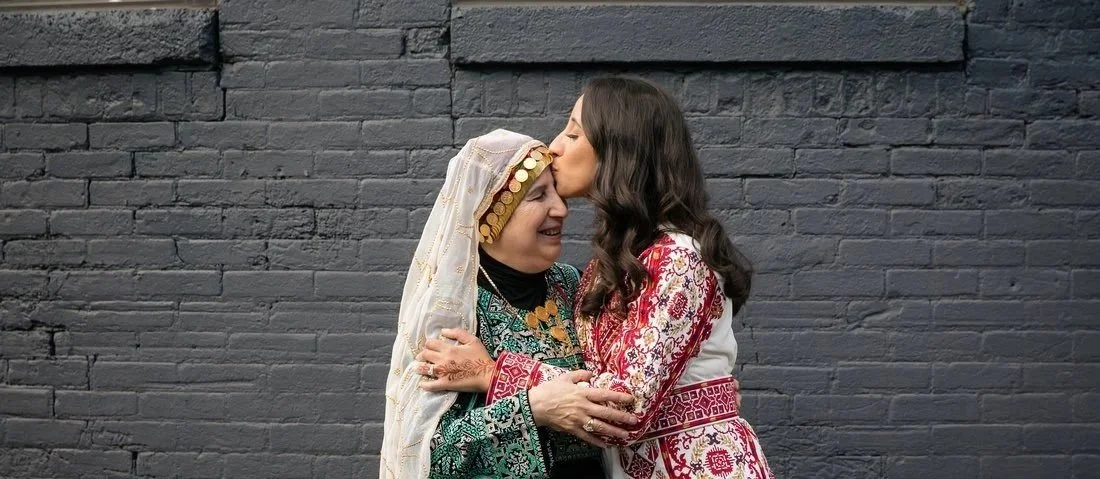
Growing up in the diaspora, I vividly remember our family phone calls from back home. My Mama would sit in the kitchen talking on the landline, and my sisters and I would listen for the sounds of our Siti’s voice or the laughs from our Khaltis. The smile on my mother’s face during those phone calls is imprinted as a core childhood memory.
Not every call was joyful. There were too many calls, familiar to every Palestinian family, that brought heartbreaking news: a family member assaulted by the Israeli military, another arbitrarily imprisoned with no idea of their whereabouts, roadblocks and checkpoints blocking our family from accessing healthcare.
After those devastating calls, I remember the lingering silence. No smiles, no laughter. Just silence.
There is a word in Arabic, "قهر”, Qahr, that expresses the feeling of anguish, rage, and suffering all at once. There is no English equivalent. It is one of those words that you can really only feel. For me, the shattering silence after those calls is a personal definition.
The landline of my childhood may be gone, but our family phone calls still keep us connected to home. These last few years have been particularly hard. As the genocide in Gaza continues, the turmoil and devastation across the West Bank feels like it is closing in. Family members have shared stories of Israeli settlers entering my family’s village at night to terrorize them while they sleep. They tell us how roads have been closed for weeks on end, blocking my family from obtaining essential goods and delaying their access to necessary medical care.
And after each call from home, that silence lingers a little longer.
This is one experience of the ongoing Nakba. Each story, each experience, each silence is another expression of the ongoing displacement, occupation, and apartheid that my family and people are enduring. I cannot help but think that the stories of our past have become our present, but I know that whatever it is, the future is Palestinian.
This Friday is Nakba Day. 78 years of dispossession, violently removing us from our native Palestinian land, and the U.S. government is still funding it.
Representative Rashida Tlaib re-introduced a resolution in Congress recognizing the ongoing Nakba and Palestinian refugees' rights, and she joined me on Instagram Live to talk more about this moment. Watch the recording here.
Our tax dollars are still funding the weapons used to dispossess Palestinians of our land and murder thousands in the effort to do so. Congress has a bill on the table to stop it: the Block the Bombs Act introduced by Rep. Delia Ramirez, which would stop U.S. weapons shipments to Israel.
The Nakba is ongoing. It’s something Palestinians have been living through for 78 years, because of the role of U.S. weapons and taxpayer dollars enabling it.
History tells us that the struggle for justice and liberation is a long-haul fight. Whatever you do, keep fighting and never give up.
Iman Abid is the Political Director at USCPR Action.
